The Brain answers from a coach, not the internet
Its coaching knowledge is a curated body of guidance with citations, not whatever a general-purpose model absorbed. Ask it why it suggested something and it can tell you where the thinking came from.
Youth football · United Kingdom
Whether you’re a parent-coach running U8s on a Saturday or an academy lead running a full phase pathway — the same AI Brain plans with you, remembers what you tried, and gets sharper every week.
Free while we’re in beta. Works in any browser — no app download needed.

“I’ve got 12 players, want to do an attacking session, attack with width — what you got for me.”
Ben Petty, Football Technical Director — the bar he set for how hard this should be.
The Brain
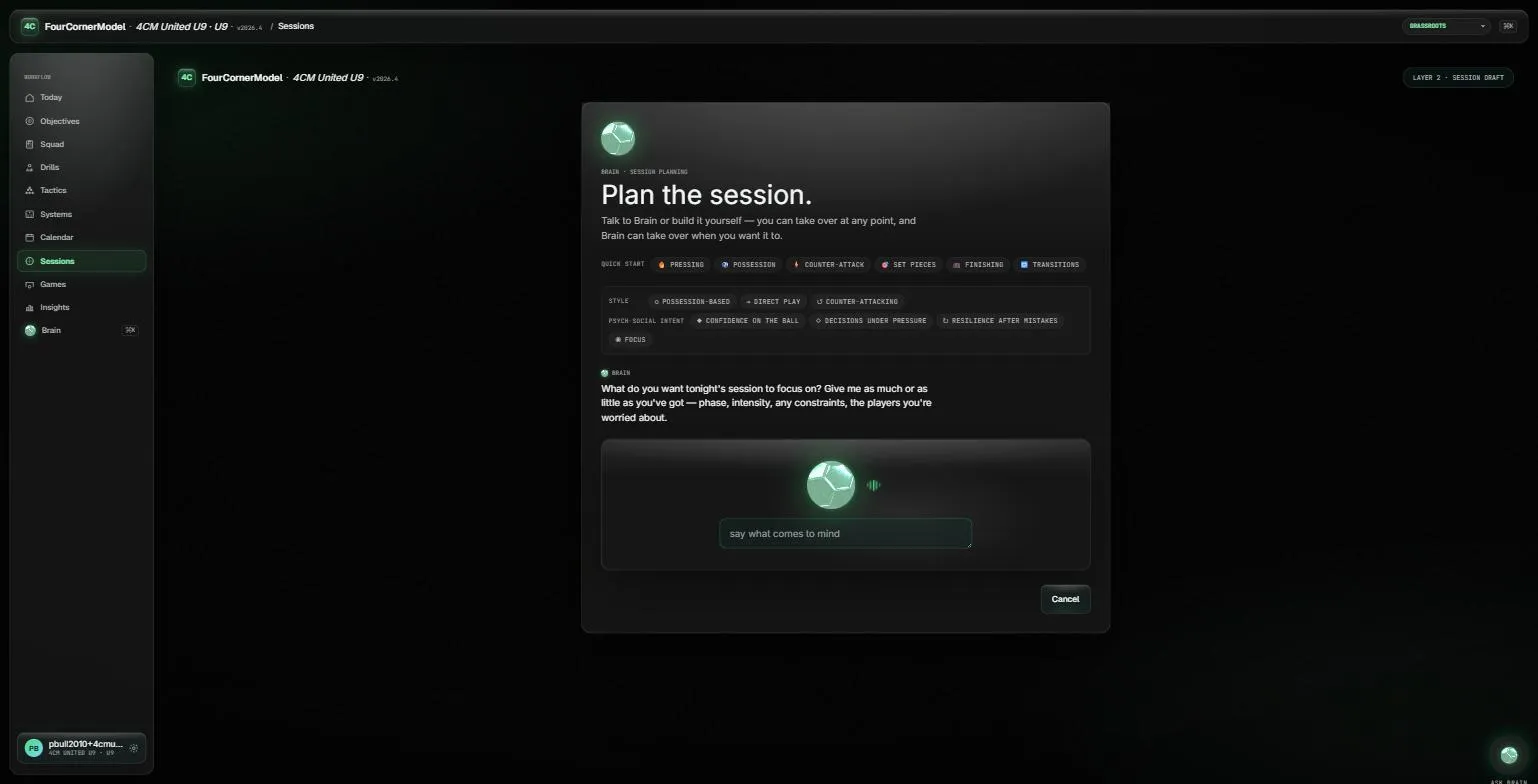
An always-on coaching assistant sitting in the corner of every screen. You speak into it, plan through it, review video with it, prep a match with it, rate players with it.
It remembers — across days, weeks, a season. What you said, what you tried, what worked and what didn’t. Ask it “what did we cover last week?” and it answers from your actual sessions, not from a manual.
It can also be wrong. It drafts; you decide. Nothing it suggests reaches a player or a parent until a coach has accepted it.
Whose coaching is this?
It is a fair question to ask of anything calling itself an AI co-coach. A general-purpose model has read the whole internet, and for youth football that means a great deal of confident nonsense.
4CM’s coaching guidance isn’t scraped. It is built from the methodology of one named technical director, recorded and structured into the knowledge the Brain actually reasons from — with the source attached to each piece of it.
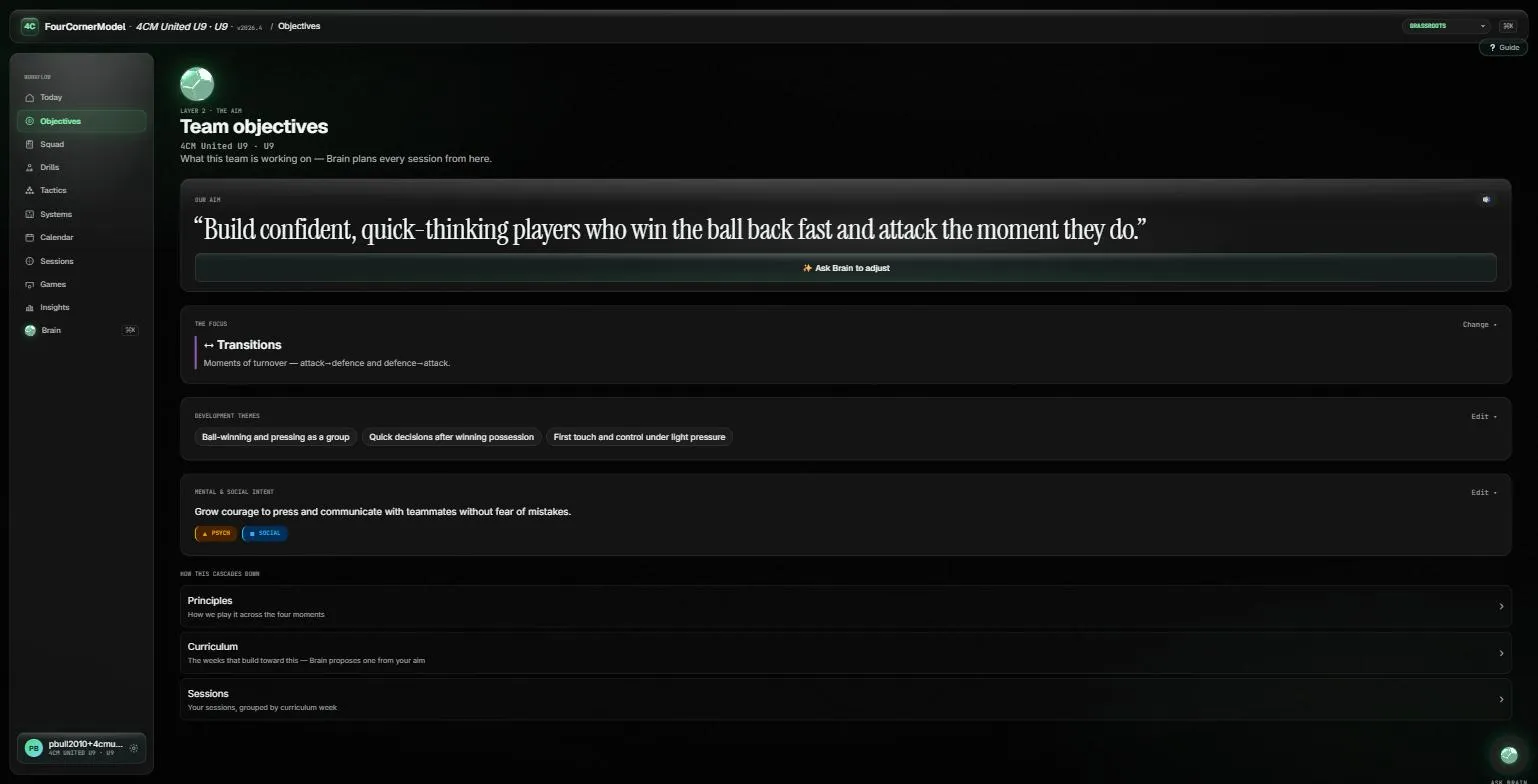
So when you ask for an attacking session for your U10s, what comes back is shaped by what he has taught the system about coaching U10s: what to expect at that age, what to leave alone, how many coaching points a child can hold, and when to stop talking and let them play.
Its coaching knowledge is a curated body of guidance with citations, not whatever a general-purpose model absorbed. Ask it why it suggested something and it can tell you where the thinking came from.
Change theme every week and it will say so. Ask for eight coaching points and it will argue for three. “Less is more” is not a tagline here — it is a rule the system actively enforces on your behalf.
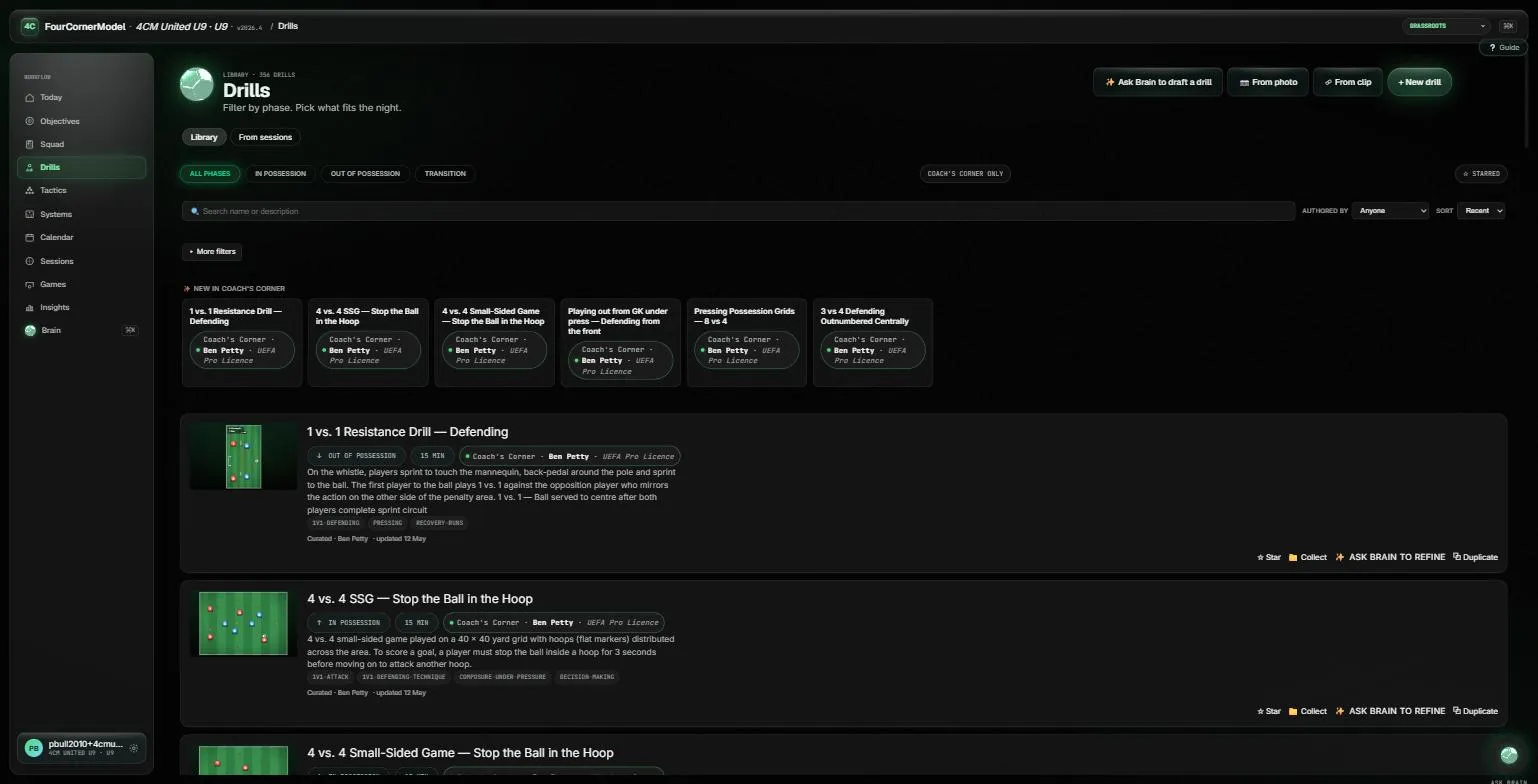
Sessions and drills authored by a named coach carry that name and their credentials wherever they appear, so you always know whether you are looking at platform content, your club’s, or an expert’s.
Monday to Saturday
What a coach actually does across a week — with the Brain in the middle of it.
Step 1
Tell the Brain your focus — “pressing with my U13s, 45 minutes, 14 players” — and it comes back with a full session: warm-up, drills, small-sided game, cool-down, with corner balance and coaching points. Photograph a whiteboard or a napkin diagram and it comes back structured. Or pull from a library of 200+ drills, every one tagged to the four corners.

Step 2
Scratch is an always-on notebook that talks back. Speak an idea on the drive home, type a player observation after a match. Every note gets a reply. Notes cluster into topics across weeks, so your own thinking becomes something you can go back to.
Step 3
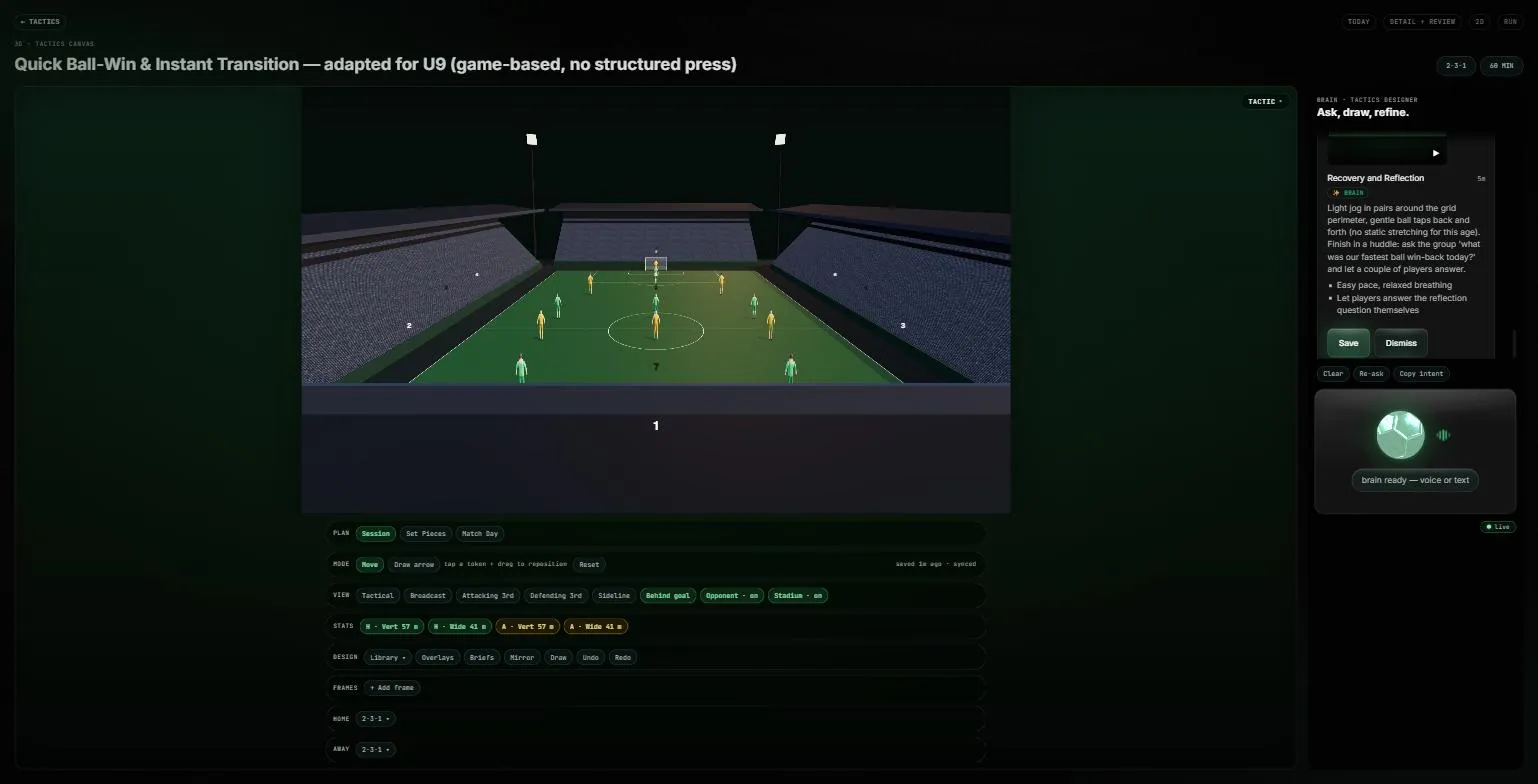
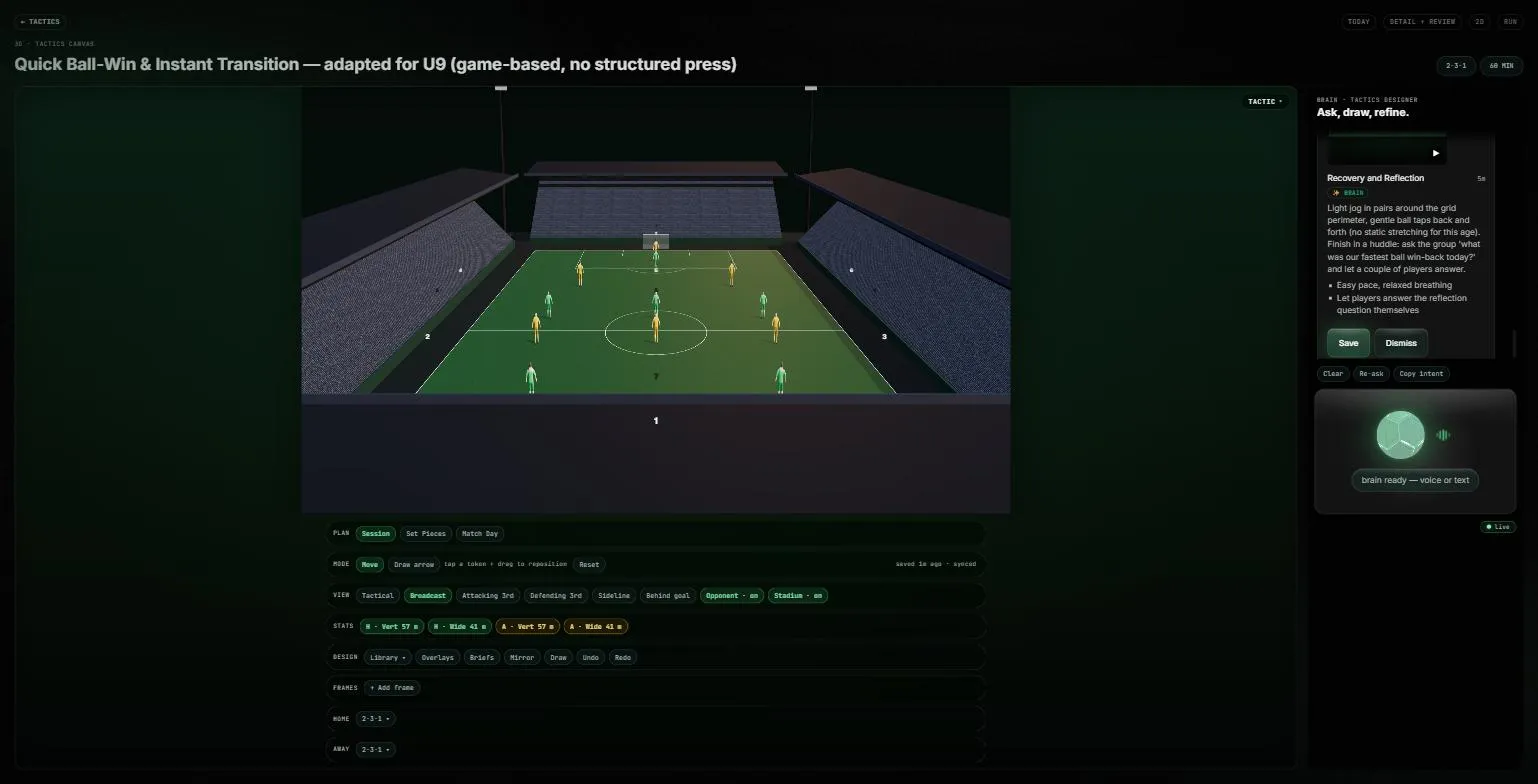
Rigged, animated players running your plays — pass, dribble, run, combine. Record a sequence once, play it back at half speed, share it with the squad. No more static arrows on a photograph of a whiteboard.

A formation-aware lineup pitch. A tactic-plan bundle — opposition shape, matchups, sub plan — in one card. Set-piece plays to share. A live transition tagger while you watch. After the whistle, a match report drafted for you to edit.
Step 5
Upload a clip. The Brain samples frames, spots events, and writes per-player four-corner notes — then talks with you about what actually happened. Clips attach to player profiles and to the curriculum. Nothing is auto-published: a coach accepts every suggestion first.
Step 6
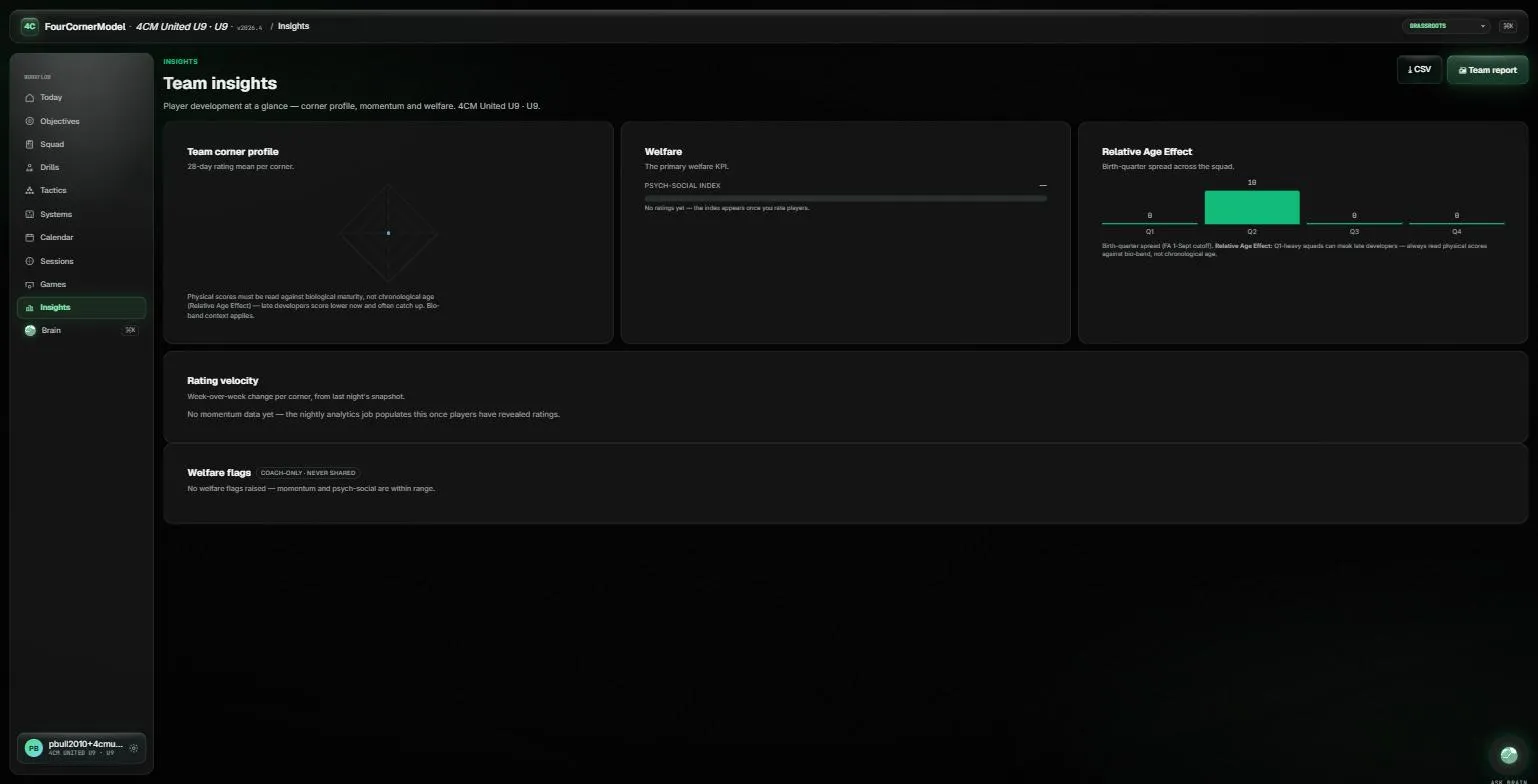
Blind coach-and-player ratings across the four corners, revealed only once both are in — so neither anchors the other. Bio-band aware, so a late developer isn’t marked down for being late. Velocity alerts when a player is quietly slipping, to the coach only. Parents see a clean, plain-English view.

Four questions, by voice or text: what went better than you expected, what didn’t land, what your team is wrestling with, and what you’d like help with next. That last answer becomes a standing instruction on every reply the Brain gives you for the following fortnight. You are the other person developing here, and most coaching software forgets that entirely.
The shared language
Every drill, rating, clip and conversation is positioned against the Football Association’s four corners — and, inside the psychological corner, against Chris Harwood’s 5Cs. These are the frameworks serious coaches already think in, so nothing has to be translated.
The skills and the game intelligence. A player can have lovely technique and still read the game badly — so these are tracked apart, not averaged together.
Always read against biological maturity, never against a birthday. An early developer isn’t better; a late one isn’t worse. The app won’t show you a physical figure without that context attached.
Chris Harwood’s 5Cs live here — the vocabulary most academy coaches already use for the mental side.
The 5Cs
Plus resilience, composure, coachability and a growth mindset.
Football is a team game, and most of these children will not turn professional. What they keep is this corner — so it is weighted like it matters.
The psychological and social corners aren’t a soft add-on — they’re the floor. A player’s composite can’t reach the top band while either is weak, because a child who doesn’t feel safe or included doesn’t develop technically either.
Most coaching software develops nobody — it stores what you already did. 4CM is built so a player gets better at football and a coach gets better at coaching, and so that each can see it happening.
A player checks in on how they slept and how they feel, then rates their own four corners. You rate them too. Neither sees the other until both are in, so nobody anchors on the other’s number — and the gap between the two becomes the most useful conversation of the week.
Every fortnight the Brain asks you four questions: what went better than expected, what didn’t land, what your team is wrestling with, and what you want help with next. Your answer to the last one becomes a standing instruction on every reply it gives you for the following two weeks.
Player accounts are for 13 and over. For younger squads the coach does the tracking and parents see it — the development work still happens, the child just isn’t a user yet.
Novice → Cat 1
The workflow that runs a Saturday U8 session also runs a four-phase academy season. You tell 4CM where you are — it changes how much it explains, how dense the screens get, and how it talks to you. Same product, five dial positions.
01
Parent-coach · U6–U10
A session in minutes, in plain English, with the jargon explained as it goes.
02
FA Level 1/2 · U8–U16
A weekly plan, a drill library, four-corner ratings and match day end to end.
03
Club / travel team
Playing principles the Brain learns, opposition briefs, set-pieces and tactics boards.
04
UEFA C / B · academy
A season curriculum broken into phases, bio-band-aware load planning, development plans.
05
UEFA A/B · EPPP
Full depth, peer-level dialogue, and a memory that holds a player’s arc across years.
You pick your level when you sign up, and you can change it whenever you like.
4CM holds information about children, so the rules that govern it shaped the product before the product had a first screen. The ICO Children’s Code, the UK GDPR, the Online Safety Act and FA safeguarding practice are not a compliance page here — they are why several features look the way they do, and why some features don’t exist at all.
Your club is the data controller. 4CM is its processor. We hold and process it on your club’s written instructions, under an Article 28 agreement, and we never train AI on identifiable data about your players.
Less is more
Every one of these would be easy to build and would probably sell. They are absent on purpose, and we would rather tell you now than have you find out.
There is no coach-to-child messaging in 4CM, and there never will be. Safeguarding guidance is unambiguous about unmonitored adult-to-child channels in youth sport. Everything reaches a child through their parent or the whole squad.
Coaches given a thousand drills jump from idea to idea and never build anything coherent. We would rather ship fewer drills with real depth — coaching points, progressions, the reason it exists — and an AI that pushes back when you change theme every week.
No ad SDKs, no marketing cookies, no selling data, no profiling children for commercial purposes. Not as a current setting — as a rule we have written into our own cookie policy.
No league table of players. Physical data always carries its maturity context, so an early developer isn’t flattered and a late one isn’t written off. Welfare flags go to the coach, never to the child or the parent.
Create a free coach account and plan your next session in about five minutes. Bring your squad when you’re ready — or don’t, and just use it to plan.
Free while we’re in beta. Players and parents join by invitation from their club — never from this page.